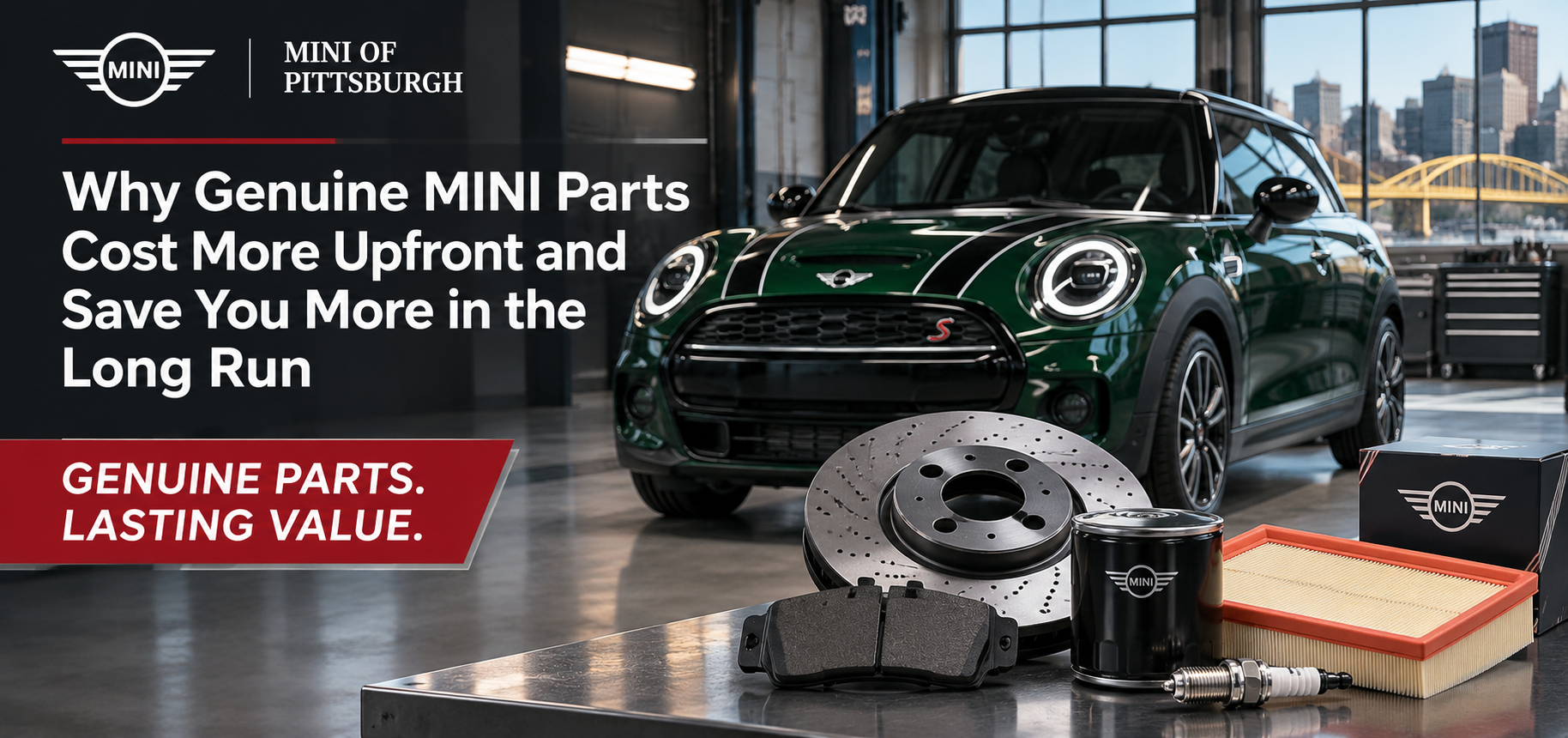
Why Genuine MINI Parts Cost More Upfront and Save You More in the Long Run
When your MINI is five, seven, or ten years old and a repair estimate lands in your inbox, the first instinct is to find a cheaper path. Maybe an independent shop. Maybe an online parts supplier. Maybe both. It's a reasonable reaction, and the price difference between a genuine MINI part and a generic aftermarket equivalent can look significant on paper.
Here's the problem with that comparison: it only tells half the story.
The other half is what happens over the next 30,000 miles. Whether that part holds its fit. Whether it carries a warranty if it fails. Whether a second repair is needed because the first one used a component built to approximate tolerances instead of exact ones. When you add up the full picture, the case for genuine OEM parts on older MINIs gets a lot stronger than the sticker price suggests.
The bottom line: Genuine MINI parts are engineered to one specification, for one vehicle. That precision costs more to produce and more to buy. It also tends to cost significantly less to own over time.
What "OEM" Actually Means for Your MINI
OEM stands for Original Equipment Manufacturer. In the context of your MINI, it means the part was made to the exact same specification as the component that came installed in your car from the factory. Not similar. Not "meets or exceeds." Identical.
Aftermarket parts are produced by third-party suppliers. Some are well-made. Many are built to fit a range of vehicle makes and models, which means they're engineered to approximate compatibility rather than achieve it. That distinction matters more in a MINI than in most vehicles.
Why MINIs Are Less Forgiving of Imprecise Parts
MINIs are compact, performance-oriented cars with tightly integrated systems. The suspension geometry, braking calibration, and engine management are all tuned to work together within precise tolerances. A brake pad designed for a general European compact may physically bolt on, but if its friction coefficient doesn't match what the ABS system expects, stopping distances change. If an oil filter's flow rate isn't matched to the engine's oil pressure specs, protection degrades.
According to MINI USA's parts documentation, Original MINI Air Filters are crafted specifically to fit the geometry of each MINI engine variant and capture up to 99% of airborne impurities. A generic filter built for a range of vehicles cannot replicate that level of fit-specific filtration.
This is the core argument for OEM parts: it's not about brand loyalty. It's about the engineering reality that precision components produce predictable results, and imprecise ones don't.
The Real Cost Comparison: OEM vs. Aftermarket Over Time
The price gap between OEM and aftermarket parts is real, and it's worth acknowledging directly. A genuine MINI brake pad set will cost more than a generic alternative. An OEM oil filter carries a higher price tag than a universal-fit option from an auto parts chain.
What the upfront comparison misses is the total cost of ownership calculation.
The Warranty Math
Every genuine MINI part sold through an authorized dealer comes backed by a 2-year/unlimited mileage limited warranty. If the part fails due to a manufacturing defect, it's covered. Aftermarket parts generally carry no warranty at all, or a limited one that requires navigating a third-party supplier's return process.
If a $40 aftermarket brake pad fails at 18 months and requires a second repair, including new labor costs, the "savings" evaporate. The OEM part, under warranty, would have been replaced at no additional cost.
The Fit-Related Repair Risk
An imperfect fit doesn't always announce itself immediately. Sometimes it shows up as accelerated wear on adjacent components. A brake pad that doesn't seat precisely against the rotor wears unevenly, shortening rotor life. An oil filter that allows micro-leakage under pressure doesn't trigger a warning light until engine wear has already occurred.
What Gets Compromised | Aftermarket Risk | OEM Outcome |
|---|---|---|
Brake pads | Uneven wear, rotor damage | Precision fit, matched friction coefficient |
Oil filter | Micro-leakage, reduced engine protection | Exact flow rate, synthetic-reinforced media |
Air filter | Incomplete filtration, engine wear | 99% particle capture, engine-specific geometry |
Spark plugs | Misfires, catalytic converter stress | Heat-resistant, corrosion-protected, leak-proof alignment |
Wiper blades | Streaking, poor visibility | Windshield-curve matched, effective for 300+ hours |
The hidden cost of aftermarket parts isn't just the part that fails. It's the downstream damage to components that were working fine before.
The Labor Factor
Here's a point that rarely surfaces in the OEM vs. aftermarket debate: labor is almost always the larger line item on a repair invoice. If an aftermarket part requires a return visit because it failed or caused secondary damage, the owner pays labor twice. The part savings from round one get consumed by round two.
The practical math: paying more for a part that lasts and performs correctly is almost always cheaper than paying for the same repair twice.
Why Older MINIs Benefit Most from OEM Parts
The OEM argument applies to every MINI, but it applies most forcefully to vehicles that are five years old and beyond. Here's why.
Older vehicles accumulate wear across multiple systems simultaneously. That interconnection means a compromised part in one area creates stress on adjacent components. The older the car, the more important it is that every replacement part performs exactly as designed, because there's less margin for error in a system that's already working harder.
Resale Value Stays Higher with a Clean Service History
Pittsburgh buyers shopping for a used MINI, whether privately or through a dealership, will ask about service history. A car with documented dealership service using genuine parts commands a meaningfully stronger resale position than one with a mixed record of independent shops and unverified parts.
According to Edmunds, consistent dealer service records are among the factors that buyers and appraisers use to assess a used vehicle's value. For a MINI, which carries a premium brand identity, that service history carries extra weight.
The Certification Factor
For owners considering trading in or selling their MINI, there's a specific financial incentive to maintain it with genuine parts: MINI Certified Pre-Owned eligibility. CPO programs require vehicles to meet strict inspection criteria. A car that has been maintained with OEM parts by factory-trained technicians is more likely to pass that inspection, opening up a higher-value sales channel.
Pittsburgh's Conditions Add Wear
This is worth naming directly. Pittsburgh's roads are not gentle. Pothole-heavy winters, the stop-and-go of Squirrel Hill and Oakland, and the elevation changes of the Allegheny terrain all accelerate wear on suspension, brakes, and drivetrain components. In this environment, the durability advantage of OEM parts is amplified. A brake disc engineered to MINI's material specifications for thermal conductivity and high-load performance holds up better on Pittsburgh's hills than a generic alternative built to average standards.
Genuine MINI Brake Discs use a special combination of materials that guarantees high stability, thermal conductivity, and durability for outstanding braking performance and comfort. Source: MINI Ireland Parts
That spec matters on a city with this many hills.
What Dealership Service Pricing Actually Covers
The sticker shock from a dealership service estimate is real, and it deserves an honest explanation rather than a dismissal. The price reflects several things that an independent shop using aftermarket parts simply cannot replicate.
Factory-Trained Technicians
MINI technicians receive brand-specific training on MINI systems, software, and repair procedures. This isn't a general automotive certification. It's model-specific knowledge that makes a difference when diagnosing an intermittent fault, calibrating a system after a repair, or identifying a wear pattern before it becomes a failure. That expertise is part of the labor rate.
Diagnostic Equipment
MINI vehicles communicate through proprietary diagnostic systems. Dealer-level diagnostic tools read the full fault code library and can perform software updates and module calibrations that generic OBD readers cannot access. When a service visit includes a diagnostic scan, that capability is included in the cost.
The Parts Warranty Is Bundled In
When a genuine MINI part is installed by a certified technician, the 2-year/unlimited mileage warranty is active. That coverage has real financial value. An independent shop using aftermarket parts cannot offer equivalent warranty protection, because the parts themselves don't carry it.
Think of dealership service pricing less as a markup and more as a bundled package:
Genuine parts with 2-year/unlimited mileage warranty
Factory-trained technician labor
Proprietary diagnostic access
Service record documentation for resale value
Quality assurance tied to the MINI brand standard
Each of those elements has a cost. Together, they represent what it takes to service a precision vehicle correctly.
The Parts That Matter Most on High-Mileage MINIs
Not every part carries equal risk when substituted with a generic alternative. On older MINIs, a few components are particularly worth protecting with genuine parts.
Brake System Components Brake pads and rotors are safety-critical and system-dependent. Genuine MINI brake pads are asbestos-free, designed for low wear response, and matched specifically to MINI suspension geometry. The rotors use a material composition engineered for high thermal conductivity, which matters on a vehicle with MINI's performance tuning. Mismatched braking components affect stopping distance in ways that don't always show up until a moment of hard braking.
Engine Filtration Oil filters and air filters protect the engine from the particles that cause long-term wear. According to MINI USA, genuine MINI Oil Filters use synthetic fiber-reinforced media with a filter area of up to 3,800 cm², and genuine Air Filters capture up to 99% of impurities using geometry specific to each MINI engine variant. A generic filter approximates these specs. The difference accumulates over tens of thousands of miles.
Spark Plugs On a high-mileage MINI, spark plug condition directly affects fuel efficiency, emissions, and catalytic converter health. Genuine MINI spark plugs are heat-resistant, corrosion-protected, and aligned to prevent leakage and misfiring. A plug that misfires under acceleration stresses the catalytic converter, which is a significantly more expensive component to replace.
Battery Genuine MINI AGM batteries charge twice as fast as conventional calcium batteries and require no maintenance. On an older MINI with higher electrical demands from infotainment and driver assistance systems, battery quality has a direct effect on system reliability.
Each of these components sits at the intersection of safety, performance, and downstream cost. They're the right places to insist on genuine parts.
Keeping Your MINI Running Well in Pittsburgh
MINIs hold their appeal over time in a way that most cars don't. Owners who maintain them properly tend to keep them longer, drive them more, and get more satisfaction from the ownership experience. The cars that hold up best are almost always the ones serviced with genuine parts by technicians who know the platform.
At MINI of Pittsburgh on Baum Boulevard, our factory-trained technicians use genuine MINI parts on every service and repair. Whether your MINI has 40,000 miles or 140,000, the standard doesn't change. The goal is the same: keep your car performing the way it was designed to, for as long as you want to drive it.
If you've been putting off a service visit because of concerns about cost, it's worth having a direct conversation about what the work actually involves and why it's priced the way it is. In most cases, the math of doing it right the first time is better than the math of doing it twice.
Schedule a service appointment at MINI of Pittsburgh and keep your MINI exactly what it was built to be.